The group exhibition of the 12th edition of Photon’s International Photography Competition, Different Worlds 2024, presents a compelling selection of ten finalists from Central and Eastern Europe (CEE), offering insight into the latest trends in contemporary photography. This exhibition showcases the creativity, originality, and conceptual depth of emerging photographers under 35 years of age, who challenge and expand the boundaries of the photographic medium. While the competition does not have a prescribed theme, the final selection often includes works spanning a wide range of photographic and photography-related practices.
Through diverse themes and approaches, the selected artists navigate topics ranging from personal and collective memory to social issues, identity, and the interplay between technology and tradition. Their use of photography extends beyond documentation, and in some cases incorporates experimental techniques. This year’s finalists present a rich spectrum of visual narratives that reflect on the contemporary condition.
Selected by a four-member international jury composed of professionals and key figures in the field of photography, the finalists’ works stand out for their strong artistic voices and innovative approaches. This exhibition was first shown at Photon Gallery in Ljubljana at the end of 2024.
Finalists:
1st prize: Olja Simčič Jerele (SI)
2nd prize: Anna Gajewszky (HU)
3rd prize: Dorka Székely (HU)
Áron Tóth-Heyn (HU), Filip Jakubowski (PL), Patrícia Koroknai (HU), Marija Mandić (RS), Artur Procházka (SK), Márk Péter Szabó (HU), Tim Topić (SI).
Mon – Fri 10 – 16h
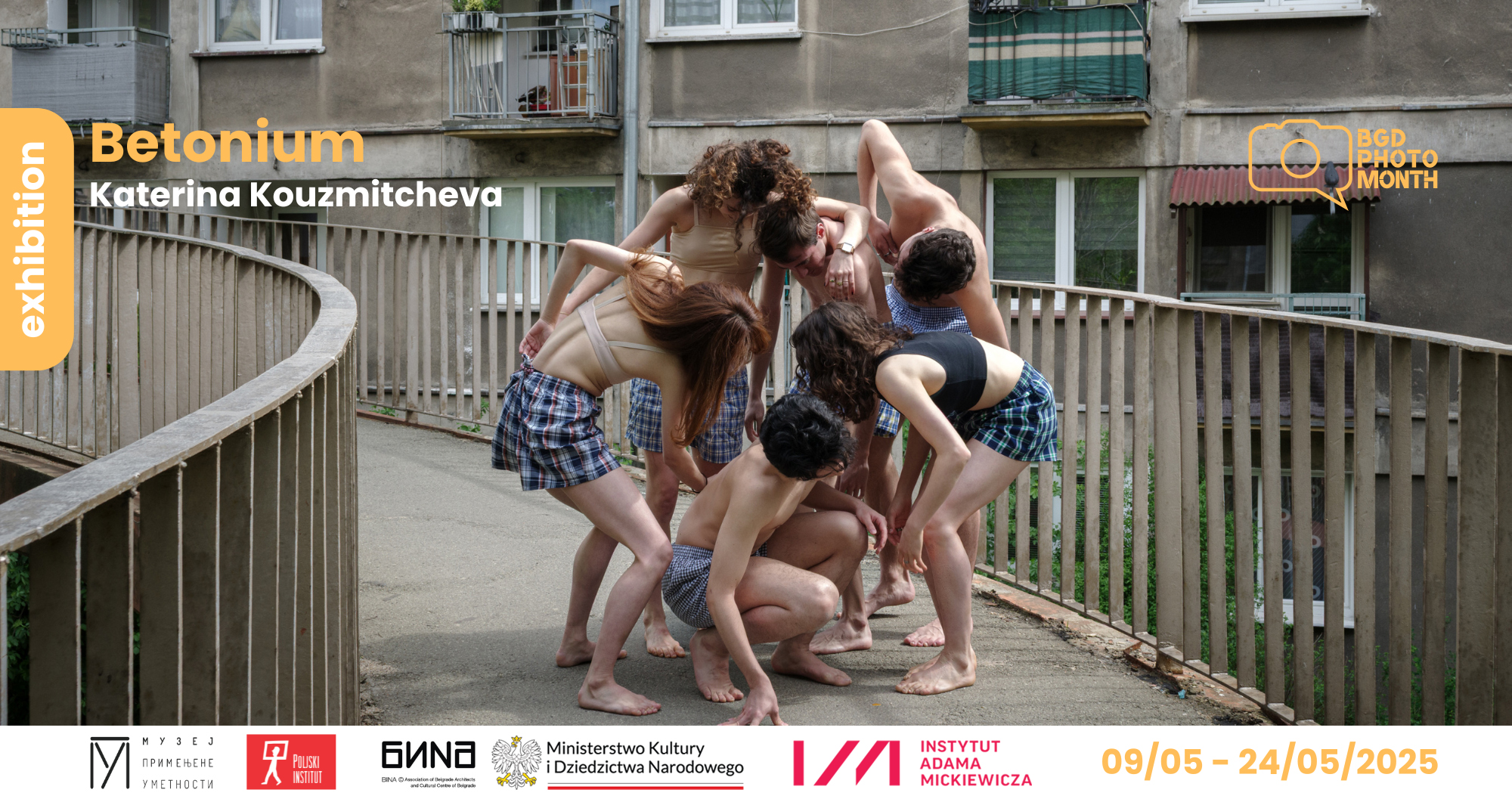
BETONIUM, created by Katerina Kouzmitcheva, investigates the relationship between contemporary identity and architectural heritage in Central and Eastern Europe, focusing on the legacy of prefabricated residential blocks as instruments of urban control and ideological power. The project explores how these structures, shaped by the policies of former regimes, have influenced the collective identity of their inhabitants.
Through artistic interventions—including conceptual actions in urban spaces, photography, performances, and collages—BETONIUM reveals the synthesis of historical and contemporary realities embedded in these environments. By creating “moving human sculptures,” the project metaphorically reflects the ideological influence on individuals, while photographic works capture the architectural commonalities across different countries. A key element of the project involves transposing images of panel-block facades from one country into another, forming a universal, imagined cityscape. These compositions highlight both the shared and divergent experiences of those living in these spaces.
Spanning 11 countries, including Poland, Slovakia, Georgia, Estonia, Serbia, and Belarus, BETONIUM documents everyday life in panel housing estates, presenting an intimate yet critical perspective. Combining personal experience with research, Kouzmitcheva challenges perceptions of postsocialist architecture, revealing its role in shaping a unique cultural identity distinct from, yet equal to, its Western counterparts.
This exhibition is made possible thanks to the Polish Institute in Belgrade and is part of the BINA Festival.
katerinakouzmitcheva.com • @katerina_kouzmitcheva
Mon – Sat 11 – 19h
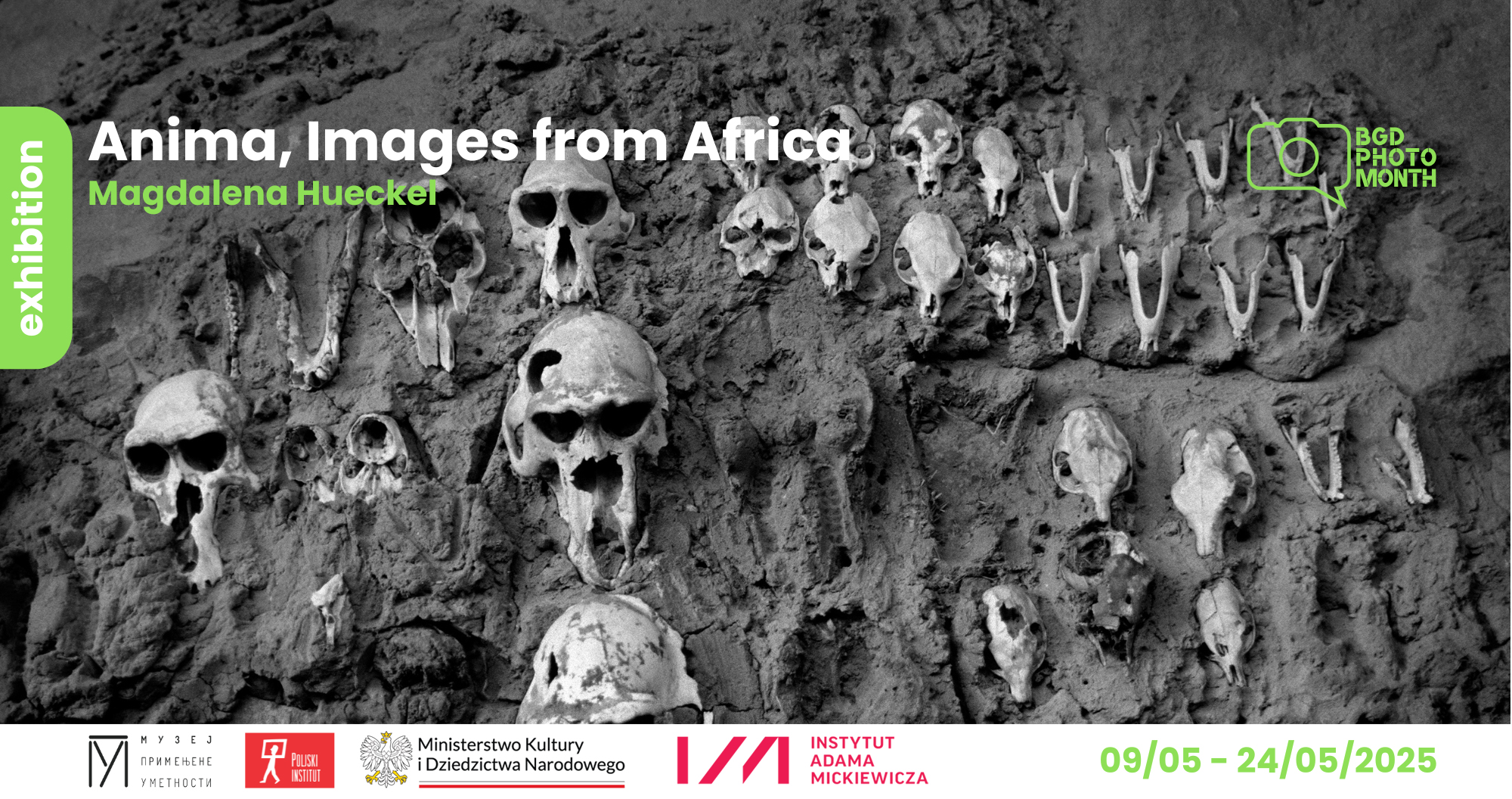
The cycle is a personal story about a journey. The images, which make up a cycle, show reality from the perspective of a Traveler, who, by penetrating the strange and incomprehensible world of Africa, tries to uncover universal truths about life, death, rebirth and transformation. The attempt to enter the invisible dimension of spirituality and immortality occurs through an exploration of images of emptiness and abandoned, neglected and ruined
sites interwoven with shots of organic structures, decaying animal matter and objects of a sacred nature.
Although the series is the result of the author’s fascination with original beliefs, spirituality, rituals, and worship of nature, it does not have an ethnographic aspect. The places captured in the images cannot be specifically identified, which serves to emphasize the superiority of ideas over reality. The images are like blocks. Anima encourages one to seek, but does not promise that the path will be a straightforward.
The pictures were taken between 2005 and 2013 during numerous trips Africa continent, spanning such countries as Algeria, Benin, Democratic Republic of Congo, Ethiopia, Kenya, Lesotho, Mali, Morocco, Republic of South Africa, Rwanda, Senegal, Swaziland, Tanzania and Uganda.
This exhibition is made possible thanks to the Polish Institute in Belgrade.
hueckel.com.pl • @magdalena_hueckel
Mon – Sat 11 – 19h
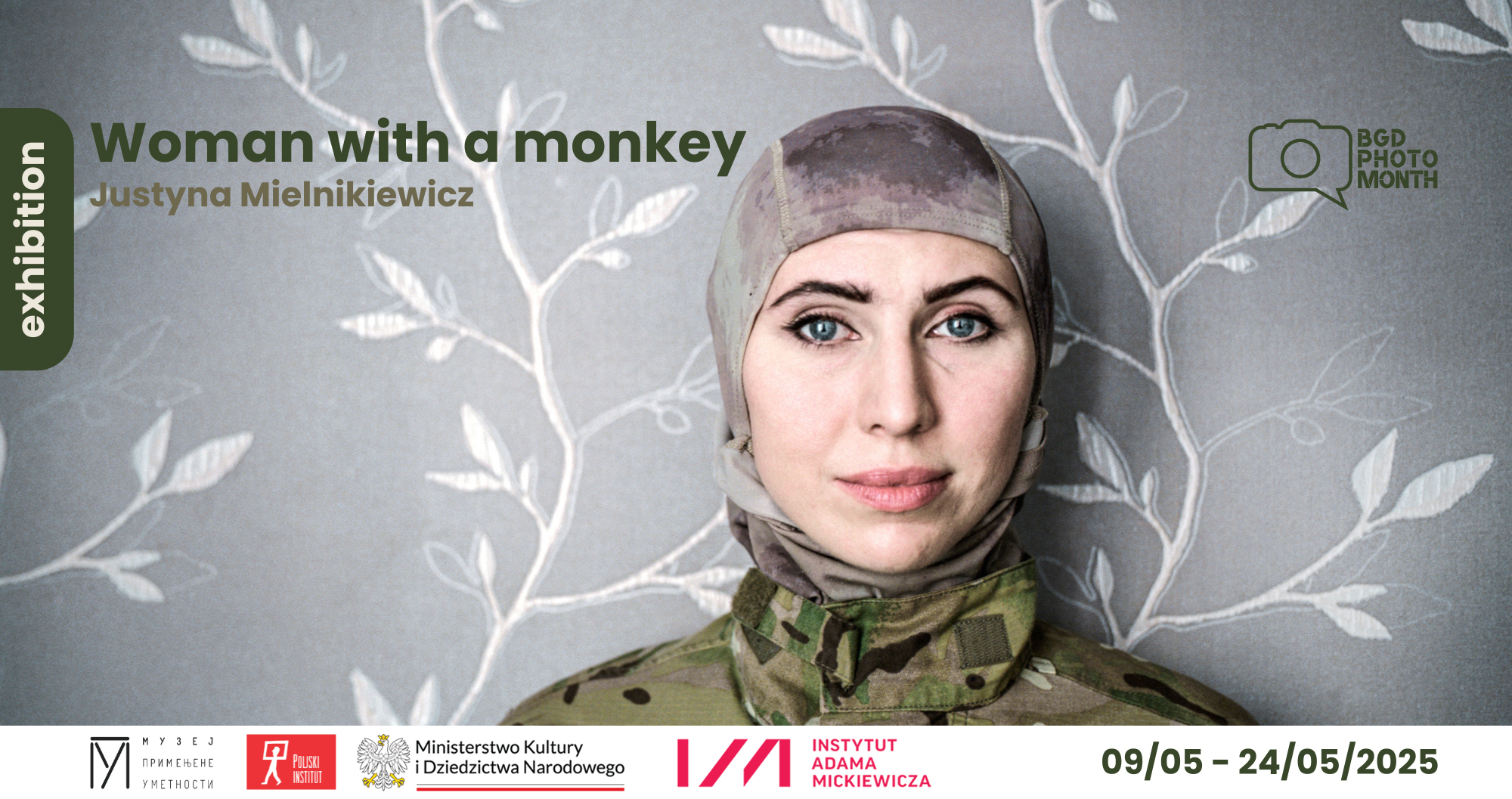
Woman with a Monkey – Afterimages of the History I Witnessed
(Afterimage definition: A visual or mental sensation that persists
after the original stimulus has ended)
The selection of images presented is rooted in various projects I made over the year. They represent my approach to news photography, which I prefer to label as documentary. Document serves beyond current events and day-to-day information. It documents not just certain events but fixates on the mood of a historical moment; it is not literal and does not require logic or explanatory elements typical of straightforward reporting. My work reflects the prevailing mood of the time and place. Most often, it is located away from a central event or at the edges of the main focus, becoming afterimage of it. Mixing personal with impersonal, that work is about dreams—imagined, lost, or transformed after the handshakes of politicians are completed for
the media. A photographer, when an artist, is a storyteller—rather than a mechanical recorder of events and life, sifting through an endless space full of information and extracting its own message out of it. The photographer’s eye is a curating one ; the photograph itself is not an explanation but a note, a color, or a shape reflecting the experience of the modern man.
This exhibition is made possible thanks to the Polish Institute in Belgrade.
justmiel.com • @justmiel
Mon – Sat 11 – 19h
A photography festival is the perfect place to discover new photographers, fresh projects, and to meet people who are just as obsessed with photography as you are. It’s a place to make contacts, show your work, or talk about the organisation you represent—yes, even that one with the long name no one remembers.
It’s also a place for lectures, talks, presentations, and masterclasses. Many of these things happen in galleries, in comfy chairs, or even over lunch or dinner—because why not mix business with a bit of pleasure? At our festival, every minute is a chance to work and enjoy. That’s our little superpower.
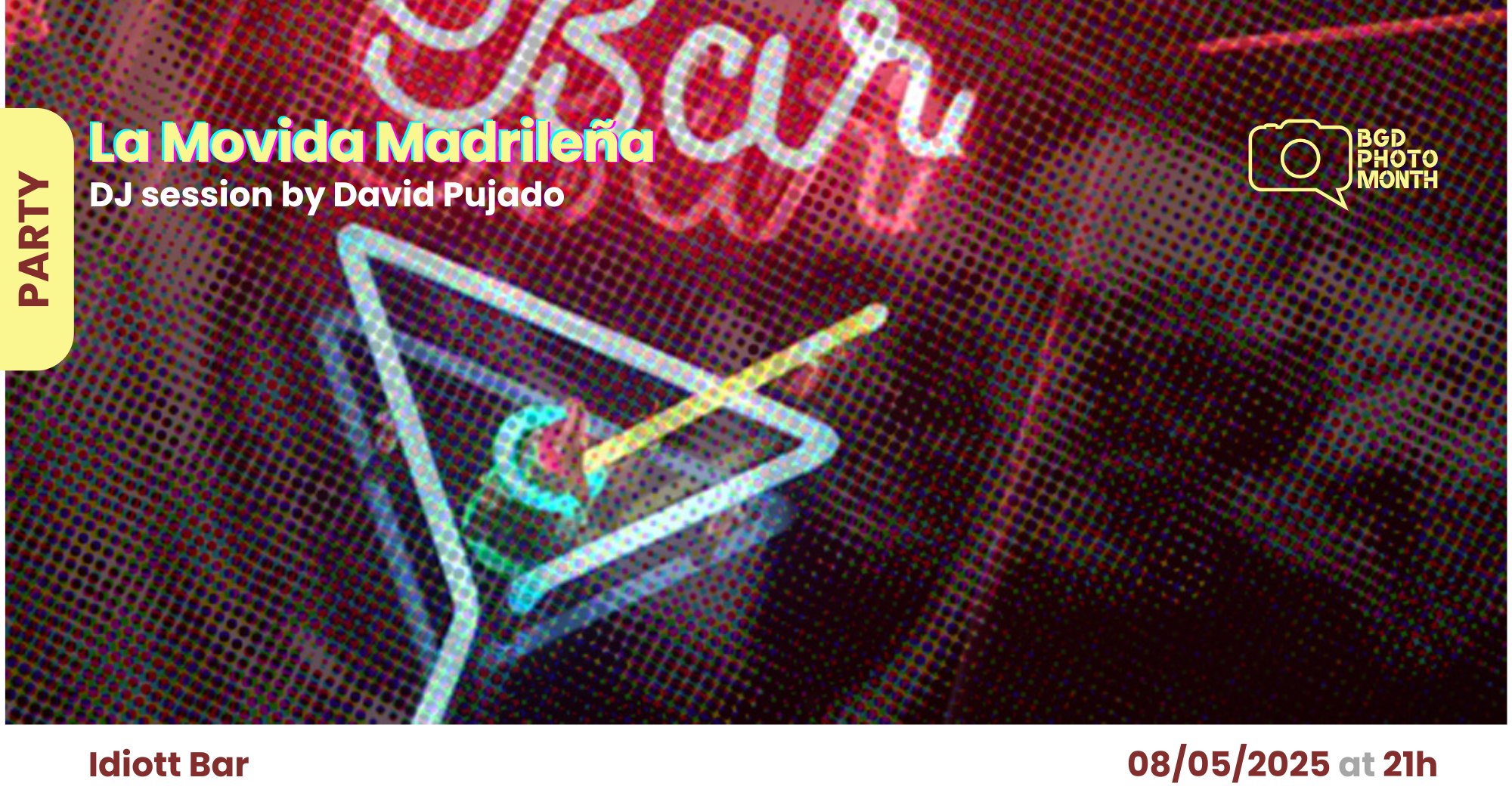
A festival is, after all, a celebration. And while we usually wrap up the month with a big party for those still in Belgrade, this year we thought—why not flip the script? Let’s start with a party! So, the night after opening BPM 2025, on the 8th of May from 21h, we’ll be celebrating our new edition at Idiott Bar (Dalmatinska 13, Belgrade). Our Director, David Pujado, will be DJing a wild mix from La Movida Madrileña.
We warmly invite everyone to join us—come for the music, stay for the madness!
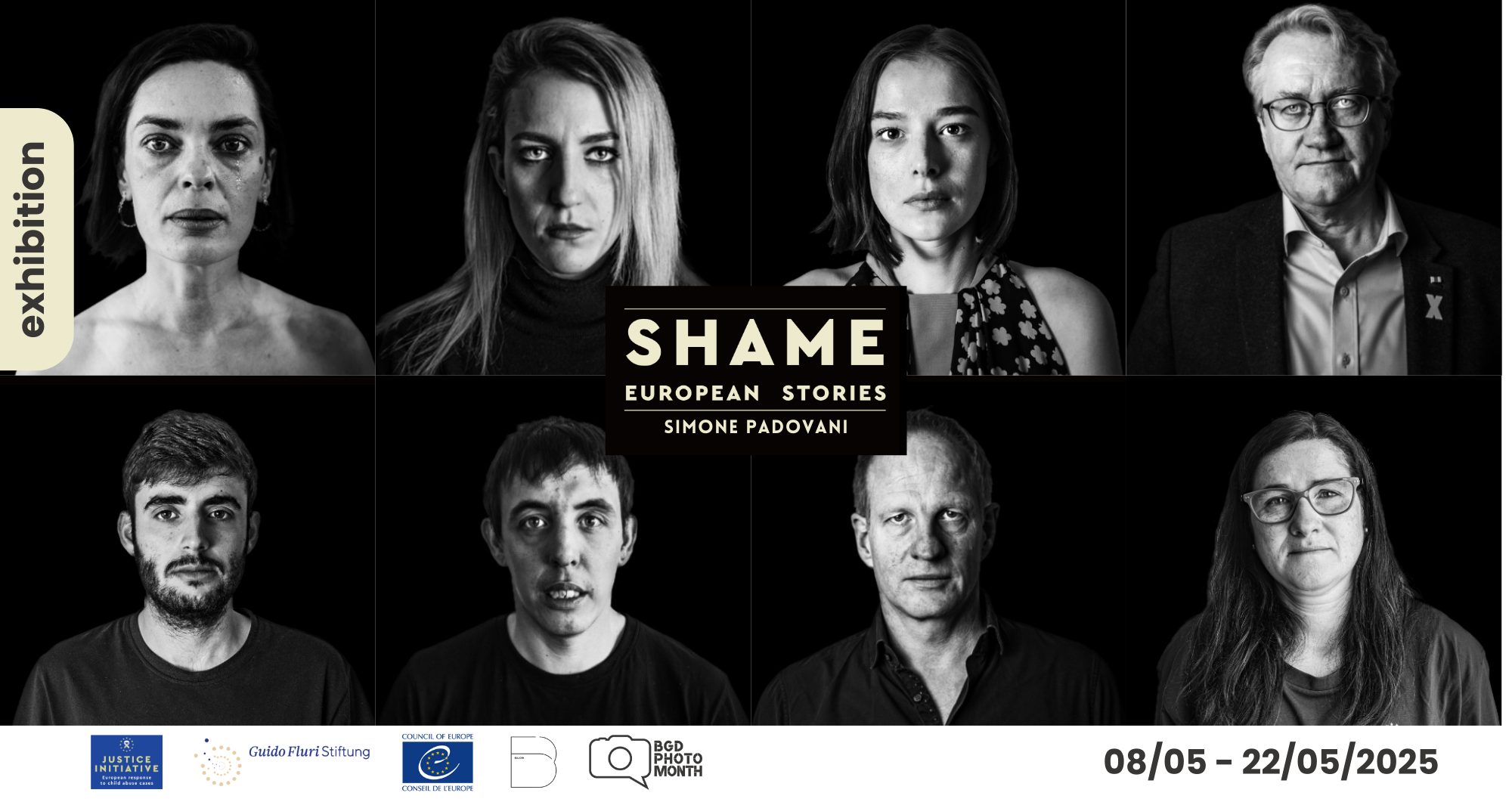
From Italy to Sweden, from Romania to Portugal: In recent months, portraits of nearly 100 victims of child abuse have been collected throughout Europe. Never has the dimension of the problem been captured in this way. Photos and videos from award-winning journalist Simone Padovani documenting
the injustices now give the victims a voice. The “SHAME – European Stories” exhibition is a traveling exhibition that has been presented across Europe, bringing to light the stories of those who have survived abuse. To date, it has been on show in more than 15 European cities and has also been hosted at the Council of Europe in Strasbourg. Belgrade Month of Photography now integrates Belgrade into this significant initiative.
The objectives of this exhibition are to raise awareness, to promote legislative changes, to break the silence, the stigmatisation, the impunity, the cover-up and even the complicity. The exhibition is organised by the Guido Fluri Foundation (Switzerland) and Justice Initiative, featuring the
photography and videos of Simone Padovani.
Simone Padovani is an award-winning Italian photojournalist contributing to international agencies such as Getty Images and Universal Pictures. His work has been published in globally recognized media outlets, including The New York Times, National Geographic, The Guardian, Der Spiegel, Focus,
among others.
simonepadovani.it • @simonpadovani • justice-initiative.eu/exhibition
Tue – Fri 14 – 19h
Sat – Sun 12 – 15h

KOURTNEY ROY
I Drink – New Orleans
Kustos/Curated by David Pujado
The series is implacable: one image is all and can be reduced to a fragment. The avatar takes precedence in a unique, unchanging narrative, where the stereotype reigns. Kourtney Roy,
photographer, actress and director makes a body, her own, available for a range of little sketches, the backdrop of which is always desolate or banal, places where bad things happen.
We are in New Orleans, a city that has not yet managed to get over Katrina, with its grim neighbourhoods, service stations and bars. Wearing a “disguise’,’ with no ostentation, a nameless character in a ‘mask’: features in them, or in fact, lives in them. ‘The bar, the karaoke stage or dancefloor house an accepted solitude that family life cannot assuage. Nevertheless, there is purposefully no pathos in the depiction. The “mask” is an obvious lure, and despite changing wigs, the modifications have no effect on the way the narra-tive unfolds, it is necessarily brutal, a lost woman in a counterfeit, illusory world.
What is the aim of this transformation? The provisional modification is intended to create an encounter with one of her potential doubles. The photographer and her character are looking for each other. Here photography reaches its aim: here, without a doubt, they find one another, they identify each other. In the framework of this piece of photographic fiction, the change in appearance is essential, obvious and tragically comic.
But the photographer does not fool us with these kitsch backdrops; of these preposterous wigs and this low-key eroticism there is nothing left but ennui and banality. We do not expect anything else, anything more off-putting, as the photographer, perhaps through empathy, pushes us to act, to put ourselves in the place off the character, the everyday neurotic” that inhabits us all. The title, “I Drink’,’ is evidence of the character s refusal to look at reality head-on, the subject that struggles to find its place in the world of language. Faced with the overdose of the world’s meanings, emptiness is the only option. Everyday life is a used-up photographic material that can no longer be approached without an ironic lightness.
The illusion contributes to the balance. The artificial nature of photography is but the metaphor of the artificiality of existence. These images are not here merely to confound or amuse the viewer. They relate the viewer to the work of the imagination, which, in the end, is the medium’s sole function.
-text by Francois Cheval, Co-director of Lianzhou Museum of Photography
kourtneyroy.com • @kourtneyroy
Tue – Sun 12 – 20h

With her photography series In Passing, artist Katarina Marković immerses us in a profoundly emotional state—a state of melancholic longing. In her works, we sense the transience of time and the complexity of situations and emotions that lie behind the beauty captured.
Katarina’s photographs, a nostalgic ode to the intimacy of life, connect us to moments from the past in a way that awakens a desire to relive them. The exhibition consists of three central events, structured as three segments forming a continuous narrative, unfolding seemingly in the same place and at the same time.
Marković’s masterful use of vivid colours and details as narrative elements is what defines and distinguishes her work. Through such an expressive articulation of sentiment, we sense that the moments captured—though fleeting—are decisive for the imagined protagonists. We feel as though we are witnessing formative moments, gestures, and impulses through which significant decisions are made.
The In Passing series, created as part of this project, is also characterised by elements of distortion, a play with lighting and sharpness. Through this approach, the artist strips the recorded sequences down to their bare impulses, leaving their ultimate truth concealed.
With In Passing, Katarina steps beyond the boundaries of the visual, introducing a new element—poetry. Her verses are tender, profound, and personal. They explore emotions of love, passion, and vulnerability, serving as a reflection of the world around her—the world we ourselves now inhabit. These original verses enhance the experience of the vivid scenes composed of carefully selected frames, conveying an intense yearning for something perhaps just beyond reach.
Whether we see in this fantasy of the conscious and unconscious a body, fear, love, or desire, one thing is certain—the compositions before us are defined by movement, making it one of the central themes to observe. Movement, as change, transience, and growth, ultimately becomes the very thing the artist confronts us with, liberating us from feelings of emptiness and helplessness.
Sofija Vučeta Posavec
This exhibition was part of our partner festival, the Sarajevo Photography Festival.
ketmarkovic.com • @keticatt
Tue – Sun 12 – 20h

tajina, noun
1. a landscape containing an attribute
[in Czech, the word tajina rhymes with the word krajina
which translates to landscape; the word base taj means a mystery]
2. sacrament; a ceremony that conveys an invisible grace
through a visible symbol [Orthodox Church]
“In 1921, a woman from South Bohemia started a diary about motherhood, and in 2021 I am continuing this diary. I think about the fact that my father’s grandmother also came from South Bohemia. I know her only from photographs and stories, yet I feel affection for her.”
The Tajina series invites us to discover the essence of the mystery, and to experience it in everyday life. It draws connections between the lives of our ancestors, their imprints in our present and their role in shaping our future. The depicted scenes are intimately connected to memory and the constant passage of time – human time appears to be rushed compared to the time of the landscape. Although rocks and stones may appear solid
and unchanging to us, they are persistently sculpted by wind, water or ice.
“Things around us change their forms, time overlaps. We are constantly standing on the borderline, and this is the moment when something opens up before us: the invisible becomes visible and disappears again.”
Text edited by Dáša Husárová.
Thanks to the Ceski Centar Beograd for their support with the exhibition and for making it possible for her to be here. We would also like to mention that this exhibition was part of our festival’s friends: Off Bratislava and Grenze Arsenali Fotografici.
martinahavlova.com • @jedenactyostrov
Tue – Sun 12 – 20h

The works from this cycle are an elaboration of the photo collage process, but also the shaping of reality through the subconscious and thus all the images we carry as archetypal heritage. It is obvious that all of the fusion, relations as well as the process, both of perception and knowledge takes place in the neural center. Spatial plans are the result of a previously generated impulse that leads to an unexpected outcome. They are the
centers of diverse conflicts. The brain, according to the definition from the age of enlightenment, is the “organ of the soul” and it interweaves the secrets of life. The immediate experience as well as the conflict of what circulates around our consciousness changes through neurotransmission into a different order.
The changed spaces in these photographic outcomes can be compared to stations, rooms and intersections. They are the composition of a struggle between archived images of the past and the sense of our imaginings. For me, photography is first and foremost a space for new content that is not just a mechanical imprint of reality. Between the moment of perception and the final outcome in the work I engage process of re-photographing,
deconstructing and unexpected layering.
I am using photo transfer of collage as a procedure that introduces unpredictable mistakes and moments of life’s spontaneity. This opens the way to depart from the perfect, multiplied image and its triviality.
@calic.maria
Tue – Sun 12 – 20h
* Galleries and exhibition spaces retain the right to change the date and time of the exhibitions and other events